
October 2024 was the month of a once-in-80,000-years comet and another super moon. I’m not big on astrophotography, but these were two events that I didn’t want to pass up.
Comet Tsuchinshan-ATLAS (C/2023 A3)
If at first you don’t succeed, try, try again.
It took me two attempts to photograph the comet. The first was perhaps a bit premature; the second paid off.
First Attempt
I knew that I wanted to get away from San Diego city lights and the marine layer of clouds that rolls in right at sunset to increase my chances of seeing the comet, so I decided to drive out to the desert on 10 October 2024, a few days before the comet was supposed to be most visible.
The website that I was using to tell me where the comet would be located in the sky showed that it would only be about 6° above the horizon and that it would dip below the horizon about 30 minutes after sunset. That posed another problem because, between San Diego and the desert are 1,800 m / 6,000 ft mountains. To get far enough away from them so that they wouldn’t obscure the comet so low in the sky, I had to drive farther to the east. I opted to head to Niland, California on the east side of the Salton Sea, 250 km / 155 miles from home.
I arrived about ten minutes before sunset, got set up, and was confident that the mountains on the horizon were low enough to allow the comet to be seen. What I didn’t count on was the amount of desert dust and haze in the air that reduced visibility just enough to make me question if I would see the comet.
I scanned the horizon in the direction of the comet with my binoculars for half an hour and never saw the comet. Disappointed, I packed up my gear and returned home by way of the In-N-Out Burger in El Centro for a late dinner.
Second Attempt
News reports said that the comet would be best viewed on 13 October, so I tried once again. The website showed that the comet would be higher in the sky at about 10° above the horizon, so I felt I would have a better chance this time around.
Instead of heading back to the flat land around Niland, I really wanted to get close to the water’s edge of the Salton Sea, so I drove 275 km / 170 miles to Bombay Beach. Even though I had driven past Bombay Beach in the past, I never stopped there and walked out on the beach before.
The Salton Sea has a long and storied past, which I won’t go into detail here. In the 1950s, it was a well-known recreational area with towns popping up around its shores to accommodate folks who wanted to spend their days on the sea in the desert. The sea is located 69 meters / 226 feet below sea level, so it has no natural outlet. That means that all of the fertilizer used in the Imperial Valley agriculture businesses runs into the sea and it has become more saline and more toxic over time. People stopped coming for recreational purposes, and the towns surrounding the sea are just a skeleton of their former selves.
The town of Bombay Beach has survived the decline, and its beach offers quirky art installations scattered all over. But the evaporation of the water in the sea has reduced the water level and exposed the ground that once was under water. It’s not sand in the traditional beach sand sense, and it’s not quite clay, either. It’s just a very soft substance that will sink a 4×4 vehicle up to its axels if you drive on it, and walking on it is a bit weird, too.
I arrived at around 6:20 p.m., just a few minutes after sunset and walked out to the water’s edge with my camera and tripod, set up, and began scanning the sky for the comet with my binoculars. Eventually, it got dark enough where the comet became visible, but it was higher in the sky than the website said it would be. That was a good thing, because the mountains on the west side of the Salton Sea were blocking more of the horizon, and if the comet was lower, I may have missed it.
I started snapping away and came up with the image you see below. But while I was so engrossed in getting the photo, I didn’t realize that, as I was standing at the same place in front of my tripod, my feet had sunk ankle-deep into the soft beach soil. I jokingly called it “slow sand”—a play on quicksand—in a post on Facebook, and a person who lives in Bombay Beach said that I was lucky. He had gotten sucked down to his waist in real quicksand nearby. I packed up my gear and returned home, muddy shoes and all.
Technical Details
My trusty 14-year-old Canon 5D Mk II isn’t the best when it comes to astrophotography because higher ISO settings tend to introduce a lot of grain and noise to the image. That meant that I wanted to keep the ISO relatively low. Of course, that meant I had to use longer shutter speeds.
In my limited past attempts at astrophotography using wide-angle lenses, I knew that I needed to stay below a 25-second or so exposure to have the stars remain as points, instead of beginning to turn into star trails caused by the Earth’s rotation. Unfortunately, using a telephoto zoom lens accentuated the star trails even at 20 seconds exposure. Live and learn.
| Camera | Canon 5D Mk II |
| Lens | Canon EF 100-400mm, f/4.5-5.6L USM |
| Shutter Speed | 20 seconds |
| Aperture | f/ 5.0 |
| Focal Length | 135 mm |
| ISO | 400 |
| Date / Time | 13 October 2024 / 19:08 PDT |

October Hunter’s Moon
October’s full moon is known as the Hunter’s Moon, and this year it was also a super moon, meaning that it is closer to Earth and appears larger than normal.
My original plan using my PhotoPills app was to try and photograph the moon rising over the California Tower in Balboa Park in San Diego. But the marine layer of clouds hung over the city all day, so I knew it would be another trip to the desert.
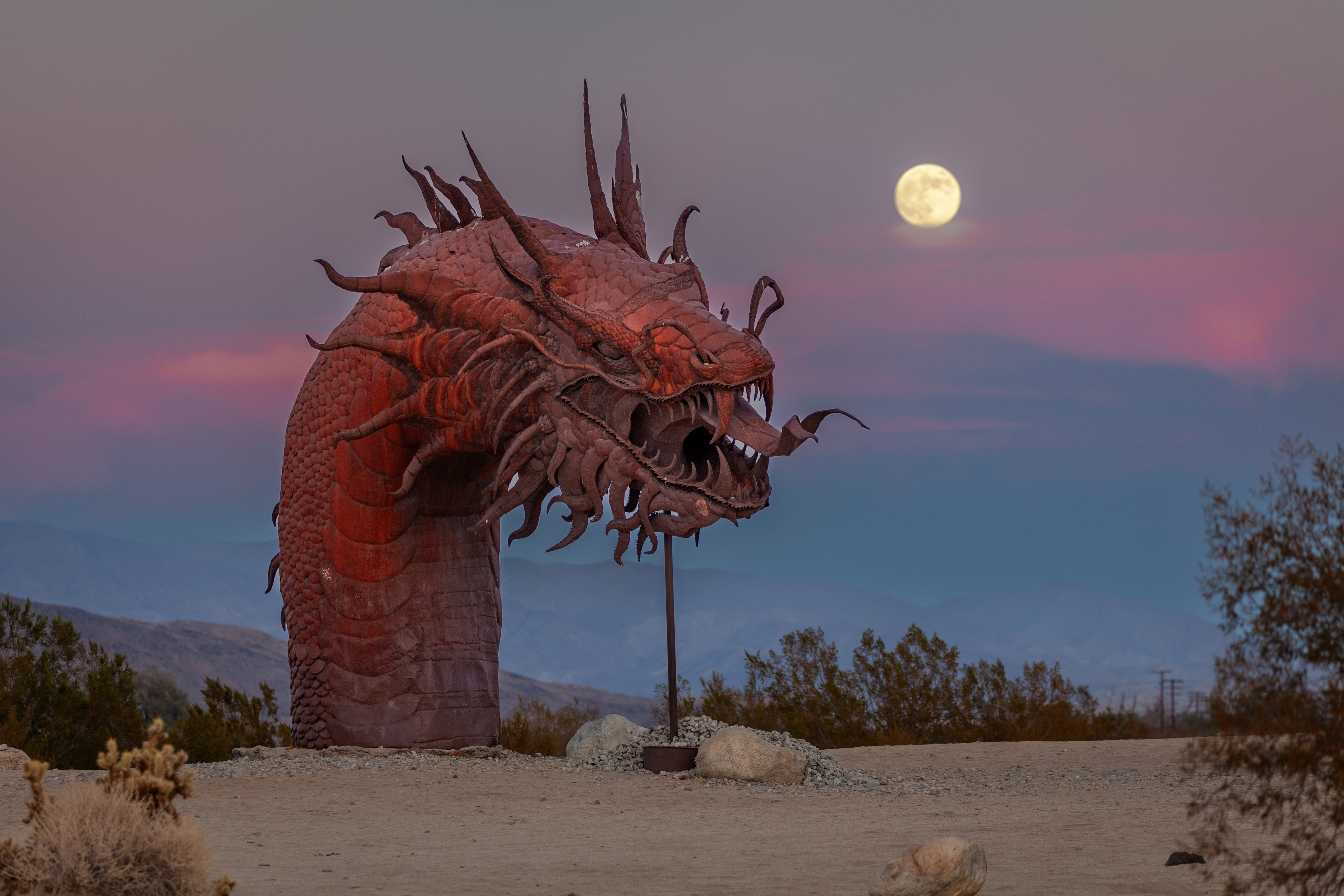
This time, I drove 145 km / 90 miles to the town of Borrego Springs, California, because I had another specific image in mind.
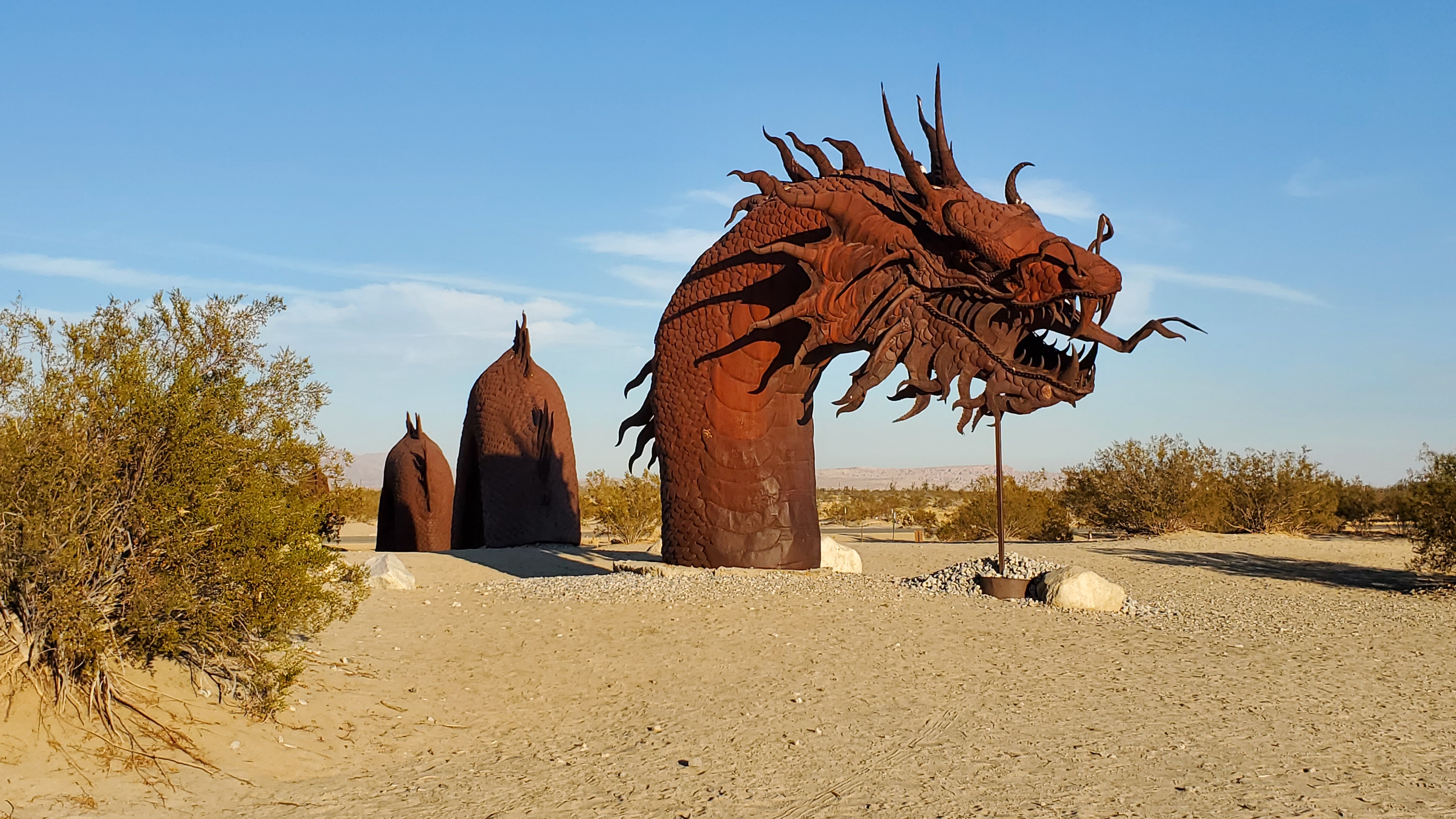
Years ago, Dennis Avery, of Avery labels fame, offered up land in and around Borrego Springs to be known as Galetta Meadows, and commissioned artist Ricardo Breceda to install metal sculptures around the town. His most famous sculpture is the Serpent. The Serpent is a 105 m / 342-foot-long sculpture that undulates in and out of the sand and is bisected by Borrego Springs Road. The serpent’s head is particularly ornate and fearsome.
My goal was to capture the moon rising behind the Serpent’s head. I had everything lined up with my PhotoPills plan, but a low layer of unexpected clouds hid the moon when it was first rising and at its largest. I adapted and came away with the image below once the moon popped out from behind the clouds, which were colored pink and magenta from the setting sun.
Luckily, the sand here was solid, and the only thing that I had to worry about was the Jumping Cholla cacti as I wandered back to my car in the fading light.
The dynamic range for this photo was quite extreme, so I had to bracket the shot with 1-stop exposures and then merge them together to get the final image below. (The second image is a cellphone photo of the Serpent while waiting for the moonrise. You can see some of the undulating humps rising out of the sand behind the head.)
Technical Details
| Camera | Canon 5D Mk II |
| Lens | Canon EF 100-400mm, f/4.5-5.6L USM |
| Shutter Speed | 1/25 second 1/50 second 1/100 second |
| Aperture | f/ 5.0 |
| Focal Length | 170 mm |
| ISO | 200 |
| Date / Time | 16 October 2024 / 18:05 PDT |
 Daniel Zeller Photography
Leave a comment